

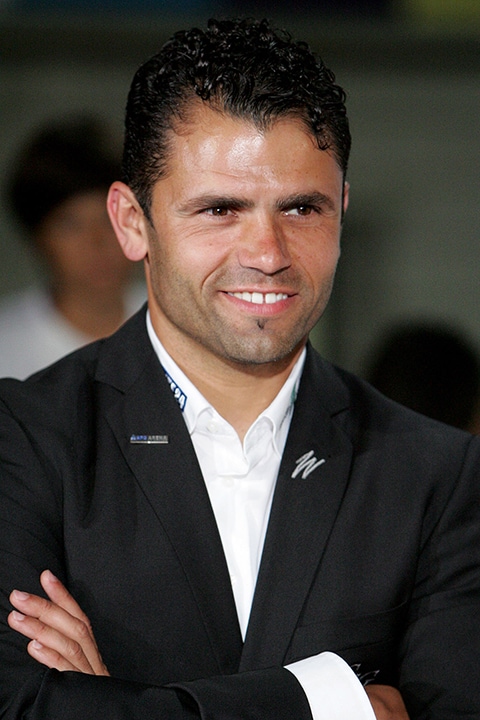
 Uli Forte, what goes through your mind these days when you see football matches played in front of empty or half-empty stands?
The feelings are very ambivalent. On the one hand we are all glad that football is being played again. Even if it gives nobody any pleasure to do so in empty or half-empty stadiums. The fans in the stadiums, with all their emotion and passion – all of that is part of football. Without fans in the stadium, football is missing part of its soul. On the other hand, the global health crisis we are still in has also put a lot into perspective. Football is not the most important thing in this world. As an Italian I experienced within my own family what effects this pandemic can have, and what tragedies and individual fates lie behind it.
At the age of 34, after Red Star Zürich (1. Liga) and FC Wil, you took over FC St. Gallen in 2008 – a team steeped in tradition in what was then the Nationalliga B – and led it straight back into the top Swiss division in your first season. If you compare Uli Forte the coach of that time with the one of today, in what ways have the man and the coach Uli Forte changed?
In 2002 I began at Red Star as a player-coach. The transition from player to coach was fairly seamless. When I took over the team in St. Gallen back then, I was only a little older than the players. And I was still a beginner in the coaching business. After promotion at the first attempt, we managed to stay up the following season with a young team. In the third season my spell in St. Gallen then ended abruptly. As a coach you have to gain a clear view straight away. You have to see where you need which players. What is decisive? All of that has to do with experience. Today, twelve years on, I deal with difficult situations and defeats better and can place them better. I still question myself as a coach, but sometimes the reasons for failure lie in the surroundings, which a coach cannot influence. Sometimes you simply lack luck in competition. In that respect I have become a little calmer.
Passion, emotion, motivation – as a coach and as a person you stand publicly for these very words. Where do you draw your strength from?
Being a coach has always been more than a job to me – it is a calling filled with passion, and I pass that on to my team before every match. Ever since my beginnings as a player-coach at Red Star Zürich I have lived this profession. I want success with my team and I am ready to do everything for it. Even when I follow a match from the stands as a spectator, my thoughts circle around line-ups, strategy and tactics. A coach needs tactical and technical competence, psychological skill, identification with his employer and with the club’s supporters. As a coach you are always in the public eye and ultimately carry the responsibility for results on the pitch. Dealing with the media as a coach is often a balancing act, particularly when things are not going well. Often the whole thing is an enormous juggling act and involves a great deal of pressure that you have to learn to handle. You only get through it if you love football and live it every day. A few months ago I became a father, which shifts the priorities a little and at the same time gives me new strength.
In the 1960s your parents came to Switzerland from Salerno with 5,000 lire and, out of gratitude, named you after the farmer who gave your family a living and a roof over their heads in Bassersdorf – in what way do your origins still shape you today, as a person and as a coach?
Where you come from always leaves its mark. I come from an Italian working-class family and accordingly I have always worked hard for my path and my successes. My parents set that example for me. Part of it is the willingness to take responsibility, a certain courage to take risks. I love challenges, otherwise I would not have taken over so many clubs in situations that threatened their very existence. At the same time, throughout my coaching career I have always tried to remain as authentic as possible, both as a person and as a coach. That includes my passion and my impulsiveness, combined with warmth and a sense of family. I see myself as a leader and nonetheless as a team player, and I know that success always has many fathers.
You studied business administration at the University of Zurich and are currently taking a sports management course at the University of St. Gallen, so you are also familiar with the mechanisms of the business world. To what extent can leading a football team be compared with running a company?
A team can only work in harmony if everyone stands up for one another and they pursue the same goals. Football is and remains a team sport. It takes a winning mindset and a culture of performance. It is no different in a company. Clear statements are required from the leadership team regarding culture, philosophy, strategy and its implementation. Managing directors and coaches are ultimately responsible for success. In their work they have to take risks and to inspire and motivate their staff and players. For a coach there is perhaps the added difficulty that he is hardly given any time to implement his own ideas and concepts. Football is strongly results-driven and short-term oriented. A sustainable, medium to long-term view is rarely found, because the commercial success of a team depends so heavily on its success on the pitch.
It is striking: not only in terms of sports management, but as a coach too you keep on training. In recent years you have completed placements with the very best in the field, such as Jürgen Klopp, Pep Guardiola, Lucien Favre, Othmar Hitzfeld, Walter Mazzarri and Mark Hughes. Which impressions have shaped you the most, and how have those experiences fed into your work?
As a person I am open, curious and always want to develop further as a coach as well. In that sense it was and is a great privilege, and extremely instructive, to gain insight into the work of the best in their field in the most varied leagues, from the Premier League through the Bundesliga to Serie A. It is of course immensely instructive to see how Jürgen Klopp or Pep Guardiola work with their teams.
What makes a good coach?
I think that the signature of a good coach can be recognised in the way his team plays. Pep Guardiola shaped an era in Barcelona with tiki-taka football. Jürgen Klopp led FC Liverpool back to the title after decades with his raiding counter-attacking football. What both have in common is that in every team they take charge of, you always see their signature.
But Uli Forte the coach also looks beyond football. With Arno del Curto you also completed a placement in ice hockey. What common ground did you find?
Arno del Curto shaped an era in Davos. As a coach he embodies a total devotion and passion for the sport, which of course fascinates me. He is also a very emotional and impulsive person. I find it very impressive how he managed to preserve his fire and his passion over such a long period. He burns for ice hockey. There is a certain type of coach who is repeatedly accused – wrongly, in my view – of having a working method that wears off because it relies so much on emotion and motivation. Arno del Curto has shown that these methods do not simply wear off, and that even an impulsive and passionate coach can stay true to himself and successful over a long period.
You can communicate with your players in six languages. How important are language and communication for a coach?
It is certainly an advantage if, as a coach, you can also convey your ideas about football in words. Not least, there is a psychological component to it. If I can talk to a player in his own language, he feels better understood and valued as a person, which greatly simplifies his integration into the team.
Anyone who has followed your coaching career in recent years might describe you as a crisis manager for hopeless cases. You are often called in when clubs find themselves in difficult situations, and in those situations you have frequently been successful. Why is that?
My passion for football transfers quickly and directly to the players. One of my strengths certainly lies in motivation and in conveying simple, clear images. Thanks to my confident and positive nature I can motivate players anew in difficult situations and instil fresh confidence in them. Often not much is missing for success. When I take over a team in a relegation battle, as a coach I cannot invest in basic work or too heavily in technical aspects – that is when the psychologist is called for. I have to send signals immediately and try with all my strength to turn things around and unite the team behind a common goal. In such situations the players often lack confidence and doubt themselves too much.
2013 was probably the most successful year of your coaching career so far. With Grasshoppers Zürich you became cup winners and league runners-up. Then came your election as Coach of the Year. What does a coach need in order to be successful, besides the usual luck in competition?
Success always has different causes and fathers. As a coach I depend on a stable and reliable sporting environment. I need the trust of the club’s management, especially in sportingly difficult times. It is no different in a company. If the board does not stand behind the managing director, failure is pre-programmed. Then you need the right playing personalities, a balanced mix of established older players and talented young ones. If, as a coach, I then succeed in forming a unit from them that carries and understands my playing philosophy, the conditions for success are in place. And in the decisive moments you also need a little luck in competition. 2013 was such a year and the framework simply fitted perfectly.
As a coach you have twice won the cup. Does the all-or-nothing mechanism of the cup suit you?
The two cup wins were certainly highlights of my career. But I also played twice in the group stage of the Europa League and am a two-time league runner-up. I see myself as an “uomo universale”. As a coach you have to see quickly what is needed, what is missing, what is decisive. I am a competitive type, so the cup format naturally suits me. In the decisive moment, whether in a hard-fought cup tie or a difficult league situation, my manner can sometimes make the difference and get the last reserves out of the players. Mobilising everyone and everything is certainly a strength of mine.
Another feature of your coaching career so far is that under your leadership young players often develop promisingly and then move on to big clubs. Examples among many are Roman Bürki and Michael Lang. What are the success factors for a coach in dealing with promising young talents?
Established players give a team security, and the young ones represent the future. As a coach you can only achieve long-term success if you let key players and future talents work and grow together. I can put myself in the young players’ position well, and I take great pleasure in working with them, both in footballing and in human terms. On top of that, many young talents are personalities with a migration background, whose way of thinking and seeing things I can readily understand.
Interview: Michael Schiendorfer