

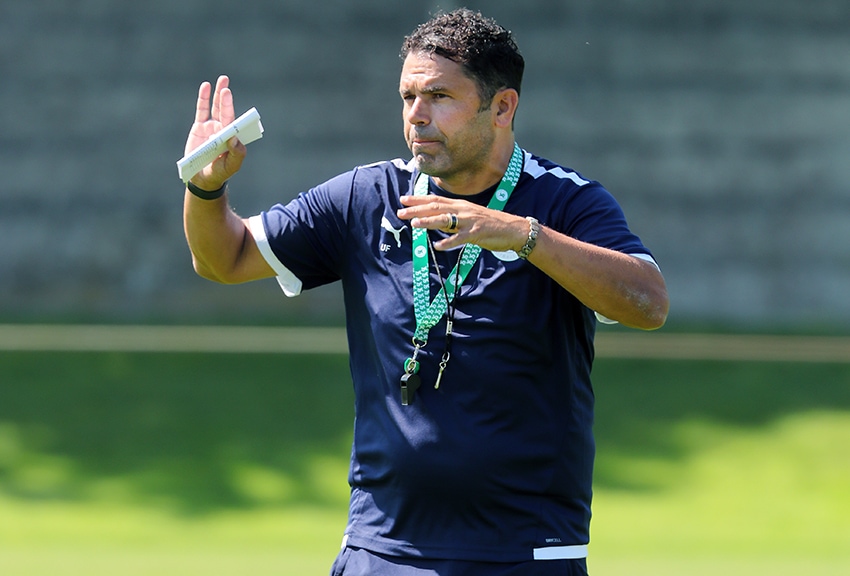
 The new coach of Challenge League club Yverdon-Sport FC has coached FC St. Gallen, Young Boys, GC and FCZ. The trained business economist has been working as a coach for almost twenty years. Before that he played for many years as a professional defender in what was then the Nationalliga B, among others at SC Kriens.
In 2009 he was promoted to the Super League with FC St. Gallen. In 2013 he won the cup and the runners-up spot with GC. With FCZ he became cup winner in 2016 and led the club back into the Super League in 2017. Uli Forte (47) knows how central functioning supply chains and the right purchasing are in the football business too.
Mr Forte, how do you buy the “right” players?
Scouting is what decides matches. Signing the right players takes a long lead time of observing, gathering information and getting to know a player. You have to try to reduce bad signings to a minimum. Many clubs save money on their scouting department, even though that is precisely the department that ought to be expanded, with a substantial share of the budget invested in it. That is a false economy in the wrong place. In the end, a failed transfer is the most expensive thing that can happen to a club.
How much influence should a coach have on player recruitment – and why?
Player recruitment is shifting more and more from the coach to the club. In the past the coach was the only decision-making body here. Today clubs increasingly influence it. The half-life of a coach has shortened massively over the past decades and clubs are aware of that. In my view the coach must have a say, because afterwards it is he who is out on the pitch with the lads every day. Even so, the coach should not decide alone. Otherwise the club may find itself, a few months later, planning with players signed by the coach it has just dismissed.
How much influence does a good coach have on the final result of a match?
On the final result, rather little. At most he can exert influence through substitutions, which have now been increased to five because of the coronavirus pandemic. But for the development of the team he is decisive. He can take it to the next level. That long-term evolution really can be attributed to the coach’s influence.
Where and how does a coach have to manage risk in order to set up a competitive team?
In football, risk management lies in how you line up the team. As a coach I have to find the right balance between attacking and defensive players. The more attacking I set up, the greater the chance of scoring lots of goals. But also the greater the possibility of not being solid enough at the back. The line-up of the individual players is one side of it. The other side concerns the players’ attitude. If everyone charges forward and no longer worries about defending, you immediately run the risk of increasing the danger.
How does the “supply chain” on the pitch have to be built so that goals can be scored or prevented?
The individual elements have to mesh and harmonise perfectly. Every single player must know how each team-mate thinks and be able to anticipate their movement. Only in that way does a synergy arise that allows teams to score wonderful goals after perfect combinations, or to prevent a goal through cooperation between several parts of the team. It is comparable to clockwork, or to a perfectly functioning supply chain in industry, trade or services.
How central is a good network for you?
A good network is indispensable in football. It gives the club access to resources from all over the world – in monetary as well as human terms. Knowing that a great talent is playing in Australia can create added value. Over time, such added value can lift a club to a higher financial level and make it more competitive. And I only find that player through my network.
How do you build a team?
First of all you always look at the existing squad and analyse whether it forms a homogeneous unit. Is there a good mix of young and older players? Is there a bigger problem on the interpersonal side? It is according to all these criteria that I try to shape the team. One of my most important principles as a coach has always been to develop young talents from the club’s own academy. A club’s own youth department is its capital. And that capital has to be developed.
Is there enough time for that?
In football the next match is always the most important one too. Even so, you want to shape a team so that it remains successful over a longer period. That balancing act is becoming harder and harder in football! Consider that the average length of tenure of a Bundesliga coach is now down to barely one year.
What abilities does a good coach need?
The purely footballing components are of course a prerequisite. What is becoming ever more important is a coach’s social skills. He has to know how to reach which players. A team consists of up to 25 players, all with different characters and nationalities. That often calls for different kinds of leadership. A coach has to master that whole keyboard. Tarring everyone with the same brush is a thing of the past.
You studied business – does a football club have to be run like a company?
Financially, certainly. In terms of leadership, a football club can only be compared with a private-sector company to a limited extent. These days a football team is a collection of one-person enterprises that have to be shaped into a homogeneous unit. What makes it harder is that every week, sometimes even twice a week, you take stock within the team. What happens a few times a year in a private-sector company is certainly done weekly in football, if not every few days. And all of it is accompanied by the media, with every word or action by a representative made public. You can imagine that the whole thing is not so easy to manage.
You recently completed the training as a certified HSG sports manager. Why?
Standing still means going backwards! I have always tried to keep learning whenever I was without a job. Most of the time I shadowed internationally successful coaches. This time the pandemic did not allow that, because either football had been suspended or afterwards no visits were possible. So in conversation with Christian Lang (Managing Director HSG) I looked into the idea of doing the sports manager training. Since I can well imagine working as a sporting director after my coaching career, I used the coronavirus period and took up the studies. It was a very enriching programme with participants from different sports and different economic sectors.
What were coaches such as Jürgen Klopp, Pep Guardiola, Ottmar Hitzfeld, Ralf Rangnick, but also Arno del Curto able to give you for your career?
They all have a huge wealth of experience. When you are allowed to look over their shoulder during daily training over a certain period, you recognise their footballing philosophy, their working methods and above all how they deal with the players. For me that was always the main focus that I paid particular attention to. All of these successful coaches have outstanding social skills and therefore a very good rapport with the players.
What did Vladimir Petkovic get right before and during the European Championship?
The national team has developed into a successful brand in world football. Despite a good deal of resistance, Vlado never abandoned his way of letting the team play. He pursued his ideas with the players consistently and never allowed himself to be unsettled by the many external disturbances. Let us not forget how much headwind he had to withstand again and again over those seven years, when the papers sometimes ran the very biggest headlines against him! In my view that is the greatest achievement, not only of Vlado and his staff, but also of the Swiss Football Association. They never allowed themselves to be distracted and went their way as a unit.
In “procuring” the new national coach, did the association make the right analysis, consider the important criteria and weight them correctly – and thus buy well?
Yes, the Swiss Football Association analysed things well and bought accordingly. In Murat Yakin it selected a man who meets every point of the profile required of a Swiss national coach. Muri knows Swiss football very well, both as a coach and as a former international. In Switzerland he has won titles as a footballer and as a coach. In addition, as a coach he has gathered experience abroad and worked in the top Russian league. As a second-generation immigrant himself, he knows the mentality of the many players with that background in the national team and can put himself in their position.
Author: Mario Walser